
I’ve been working on an ongoing series called “Art for the Commoner: A Guide to Appreciating Craft Without an Upturned Nose.” As a girl who grew up in rural Idaho with a creative streak but very little access to “artist culture”, I’ve always felt out of place when it comes to walking into a creative space.

I am 100% stereotyping here, but as someone whose closet is noticeably absent of berets, doesn’t chainsmoke, and doesn’t actively seek out performance art, I’d often get to something artsy and go “I don’t get it.”
If you’ve ever felt alone in your confusion when standing around a painting, I want you to know that it’s okay, and you’re not doing art wrong. I’m hoping to give you some new ways to look at the way you approach art, style, design, and tastemaking.
And maybe make you feel like you are artsy like you, not artsy like them.
So without further ado… Our first installment of Art for the Commoner:
Thrift Stores are Museums for the Commoner
And by that, I mean that they’re free, full of interesting stuff, and they’re everywhere.
My friend Kendall and I have made a hobby of thrifting, and an impulsive ritual of each thrift date is picking up an object – maybe a weird little handmade bowl, or a tiny, framed art someone’s kid made – and going “isn’t this cool?”
The other will nod “ooh I like that”, maybe noting something about the color, the material, or giving it a little tap of appreciation. Usually the object is put back, sometimes it’s added to our collection of treasures.
Then the ritual continues.
This “ooh/ahh” isn’t unique to thrifting. It’s the same thing we do when gazing at a Van Gough in the MET, though I would argue the thrift-store-pick-up is the purest version. It’s stripped of any haughtiness or “deeper-meaning-seeking” that you feel obligated to give when looking at a famous painting from a dead guy.
It doesn’t have to be that deep. And when that expectation is stripped away, you sometimes accidentally find yourself digging deeper.
Drinking Design from a Fire Hose
Going to a thrift store (or antique store) gives you an intense, varied, and involved education on style, taste, and design. One minute you’re looking at glassware, the next, you’re looking for vintage Levis. Within a span of minutes you’ve accidentally exposed yourself to a range of eras, styles, color palettes, handmade, factorymade, actual garbage – and whether you notice or not, you’re making observations.
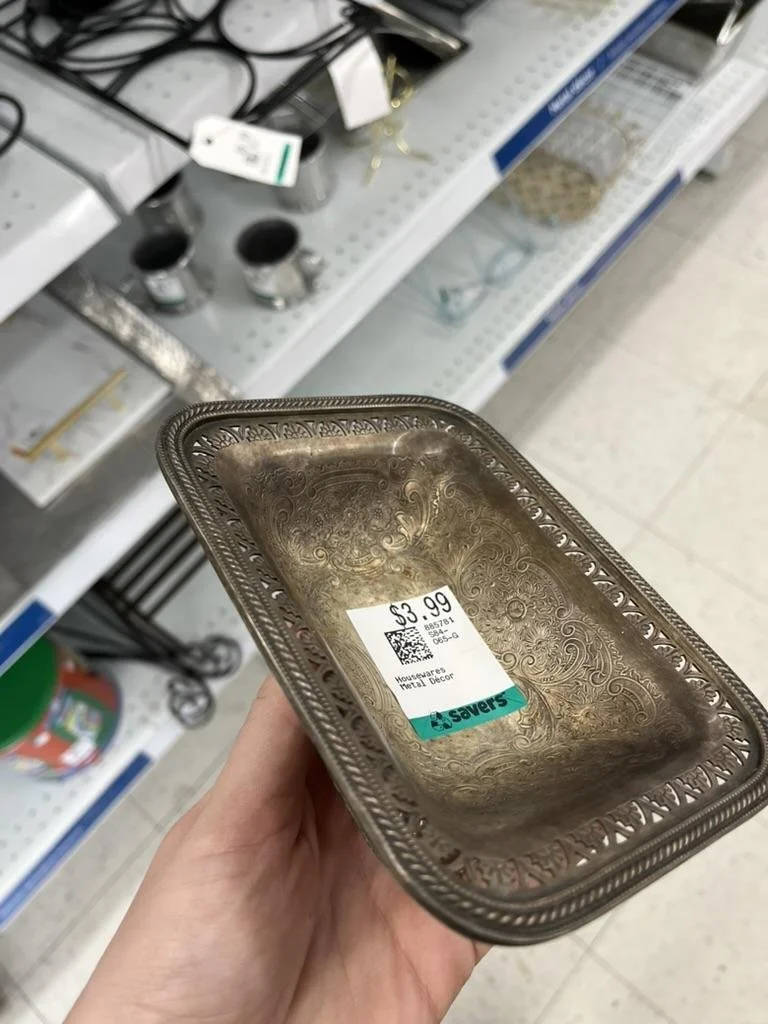
Thrifting turns passive observation into active scavenging. Where museums have a job called “Museum Curator”, thrift stores decidedly do not. (Unless you count Bob in the sorting division labeling vintage Italian loafers with “$4 Womens Shoes” as curation).
You are The Curator.
While some might call it sensory overload compared to observing a single portrait on a long wall, the thrift store trains your eye quickly: You identify and appreciate a pop of color in a handmade painting amidst discarded Hobby Lobby art, the texture of a well-made linen blouse amidst SHEIN replicates, the careful craft of dovetail drawers amidst walls of IKEA boxes.
You are learning to appreciate craft. You’re asking questions about what something could be used for, or how it was made. Yes, you are assigning value when you add-to-cart, but other times you are simply appreciating.
Shoulderpads and Defining Your Taste
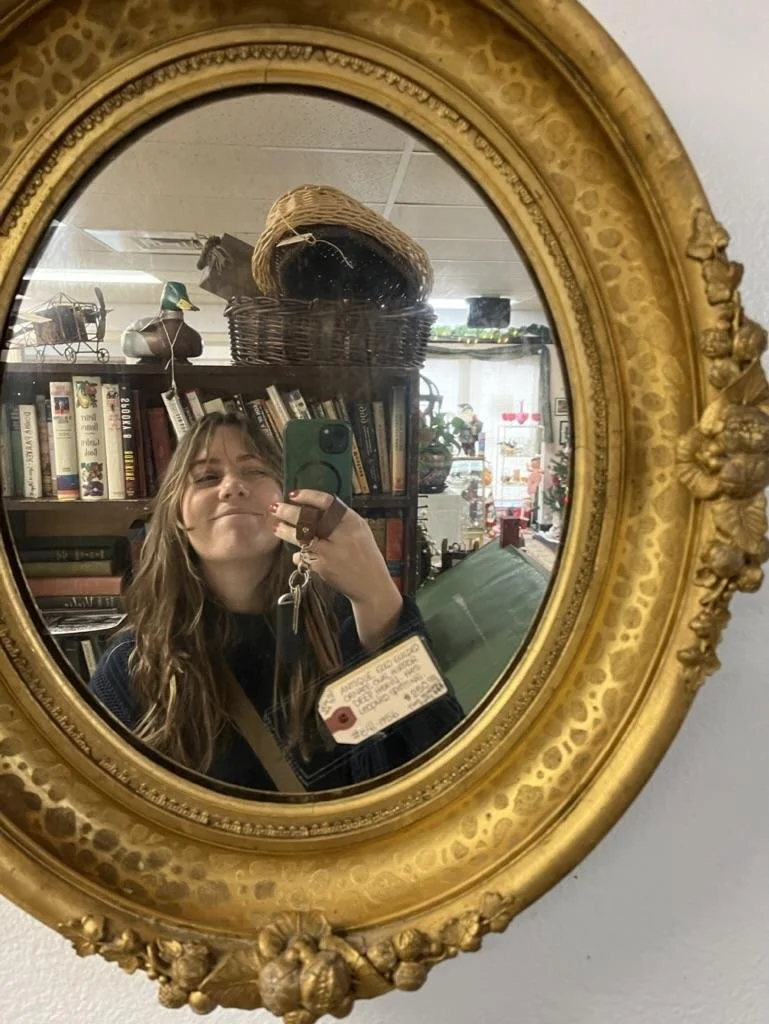
Where going to a museum might feel like you are trying to discern something about the artist, in a thrift store, while holding a blazer with shoulder pads, you are free to discern something about yourself.
While that discernment might be “I can’t pull off shoulder pads”, it could also be “This piece gives me confidence. It makes me feel comfortable. I feel a connectedness to the person who donated/made this.”
(Don’t worry, most of the time I’m not feeling a deep connection to L.L. Bean, but ya know, sometimes Bean makes me think.)
Sometimes I’ll pick something up and go “Kendall this is so you.” and she adds it to her treasures. She does the same for me. Even though we go to thrift stores together and look through the same stuff together, we have each defined our own unique and distinct taste.
And sometimes, we will pick something up that is not either of our tastes. We will appreciate the artistry, go “ooh/ahh” – and then we put it back, a little bit more in view than it was previously shelved, hoping someone else will pick up and appreciate.
Until Next Time,
STSc


About Gouache
Gouache is like watercolor’s older sister. It does everything watercolor does, and then also everything you want watercolor to do doesn’t.